
Thought
Designing for Decisions: Building EVORA Analytics Around Real Reporting Workflows

Real asset investors are under pressure to show how sustainability performance links to risk, value and regulatory commitments – without adding another layer of admin. EVORA Analytics was designed with that in mind: start from how people actually work with sustainability data, then shape the product around those behaviours.
This piece looks at how UX decisions in EVORA Analytics support real decision-making rather than adding unnecessary complexity for your team.
Designing for Diverse Teams
Users and end users are very different. We have diverse clients where different roles interact with EVORA Analytics in different ways. One Sustainability Director might want a hands-on approach, acting as the admin in Analytics and guiding colleagues through the outputs. Another Sustainable Director might prefer to step back and let their team handle the tool while they focus on higher-level view of reports. That shows how two seemingly similar user archetypes can have very different needs from EVORA Analytics. Even our own EVORA consultants, who we consider heavy users, will have different purposes within reports.
Those purposes vary: some people only want to see the finished reports, while others want to view underlying data. This is why creating an inclusive platform is really matters. Designing for this fit means the product can’t assume a single level of expertise. Permissions, layout, and language must work for someone who not only wants high-level statistics but also someone who needs to go deep into a granular data point that might trigger an escalation, a net zero adjustment, or a new conversation with investors.
EVORA Analytics sits on top of a single data backbone rather than a patchwork of spreadsheets and exports. Data is ingested, validated and structured once, then surfaced through different views and reports. The UX then focuses on making that data meaningful, usable for different roles, rather than rebuilding the data each time.
Design must make decisions, easier, irrespective of user. This is how EVORA Analytics’ impact can truly be measured.
Mapping the Path from One Number to a Decision
Inside EVORA Analytics, there’s a lot of information, but that doesn’t automatically translate into clarity. The design team treated “clarity” as a concrete question:
What does the path from a value on screen to a real-world decision look like?
They mapped how different users move through the data. A consultant or analyst might start at portfolio indicators, filter by framework or geography, move down to asset level, and finally drill to specific readings behind an outlier. At each step, the question was why they go further: are they chasing an anomaly, preparing a board paper, explaining a variance to an investor, or checking the impact of a retrofit or acquisition?
Just as important was agreeing where that journey should stop. At some point, the platform needs to present a result that is detailed enough for an asset manager or consultant to make several possible decisions off-platform – without encouraging endless drilling simply because the option exists. We are not viewing data journey just within our interface, but what happens after its presented.
“The risk isn’t oversimplifying. The risk is over-engineering, because you’ve used tech resources for something users aren’t using. Over-engineering shows up as extra steps, extra noise, extra confusion for analysts and asset managers who just want to get from a result to a decision without fighting the interface”, Gobi Aroganam, UX Researcher at EVORA, explains.
That’s why you see drilldowns, filters and tool tips where they help someone reach a meaningful decision point faster, not as a way of demonstrating how many interactions the interface can offer. The aim is to shorten the distance between “this number looks off” and “here’s what’s driving it and what we do next”. This can directly be a measurable success metric.
A Report Repository Built for Reporting Reality
When EVORA asked clients what they needed, one request came up repeatedly: give us a single, structured place for our sustainability reports that reflects how we work. Not just dashboards, but compulsory framework submissions such as GRESB, EPRA, INREV, SFDR, Net Zero etc. Different frameworks require different data preparation, calculation and submission. These reports can have varied uses, such as investor updates, analysis or internal company policies. That’s why the report repository is a core part of EVORA Analytics rather than a side feature. It behaves less like generic file storage and more like an operating layer for sustainability reporting.
Users can keep different report types in one place, tagged with framework, frequency, owner, upload date and approval status. That sounds simple, but it addresses the questions that waste the most time in reporting cycles: Which version is the latest? Is this annual or monthly? Who do I speak to if something looks wrong? Can I safely use this in a board pack or investor letter?
The repository is also format-agnostic. Word, PowerPoint, Excel and PDF reports can all be stored; PDF and Power BI dashboards can be opened and interacted with directly in EVORA Analytics instead of sending people out to separate tools. On top of that, permissions can be configured so internal teams, external managers and EVORA consultants all see what they need, and only what they need.
In practical terms, the repository cuts friction rather than adding another place to look.
Built on Research, Not Assumptions
EVORA Analytics sits on months of primary and secondary research conducted that coincided with design work. The team started by listening widely: client sessions where both the contracting lead and the end user were present, and internal interviews with EVORA’s Reporting & Analytics consultants, who carry much of the reporting workload across different frameworks.
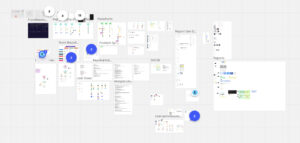
Months of research went into creating EVORA Analytics
Conversations were about real reporting work, which reports are prioritised, how often they’re produced, where workarounds fill gaps, and which parts of the process cause the most delay or risk. From there, the UX team built flows and storyboards, then high-fidelity prototypes that clients could click through as if they were in the live product. Gobi Aroganam and the team pushed those sessions beyond showing some slides and into hands-on testing:
“I let them go through it themselves. In the prototype I made everything clickable so it felt like a real website. That’s when they started recommending changes – I remember one client saying you can move the approval phase to the end rather than in the middle of the process, and that stuck with me because those small changes aren’t just for them, they’re for the overall business.”
That attitude to testing runs through the work. Positive feedback is welcome, but it isn’t the benchmark for success. Gobi Aroganam explains:
“I did usability tests with clients and the response was so positive that we knew we were on the right track. But validation doesn’t always equate good product – most of the time it just means you’re going in the right direction. We have to make sure we’re not complacent.”
That attitude extends to how feedback is handled over time. EVORA has set up a recurring product client group to review features across portfolio views, reporting and data management. A standing brief has to be specific and tough feedback rather than polite is what the design team desires for a stronger product. The goal is to keep grounding design decisions in how investors, asset managers and consultants actually work, not in what looks impressive in a demo.
For investors and operating partners, that’s the point. EVORA Analytics isn’t trying to impress with visual tricks. It is being built, tested and refined against the realities of ESG reporting and stewardship: getting from data to a defensible decision, reducing avoidable process risk, and making it easier to explain how sustainability performance links back to asset value.
If you’d like to see how that design work plays out with your own portfolios, you can book a demo of EVORA Analytics and walk through it with the specific decisions you need to support in mind.